
Peter Krauskopf Germany, b. 1966

Peter Krauskopf's painting articulates abstraction as a durational field, where colour, surface, and erasure register time as a material condition rather than an image.
Peter Krauskopf (b. 1966, Leipzig) is an established German painter whose practice is grounded in process-based abstraction. Working primarily with oil and acrylic on canvas, Krauskopf develops paintings through successive acts of layering, overpainting, and partial erasure. His works are not conceived as compositions in the traditional sense, but as accumulations-surfaces shaped by time, pressure, and material decision-making.
Educated at the Hochschule für Grafik und Buchkunst Leipzig, where he later completed a Meisterschüler program under Arno Rink, Krauskopf belongs to a generation that emerged from the Leipzig context while deliberately distancing itself from narrative or figurative tendencies. His work has been widely exhibited in institutional settings, including the Mies van der Rohe Haus, Kunsthalle Lingen, and Kunsthaus Kaufbeuren, and is held in major public collections such as the Albertinum Dresden and the German Bundestag collection. In 2015, he received the Falkenrot Prize in Berlin.


Peter Krauskopf (b. 1966, Leipzig) is an established German painter whose work articulates abstraction as a durational and materially grounded process. He studied at the Hochschule für Grafik und Buchkunst Leipzig between 1989 and 1995 and completed his Meisterschüler under Arno Rink in 1997. Although his education coincided with the rise of the so-called Leipzig School, Krauskopf consciously distanced himself from its narrative and figurative tendencies, instead developing a sustained investigation into abstraction, surface, and temporality.
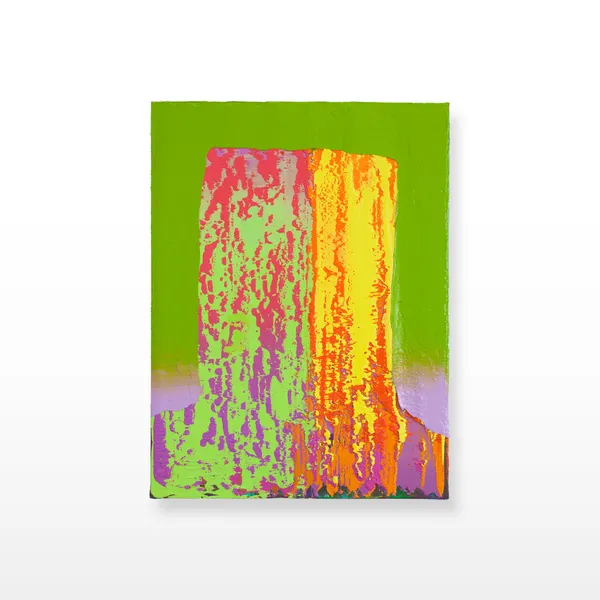
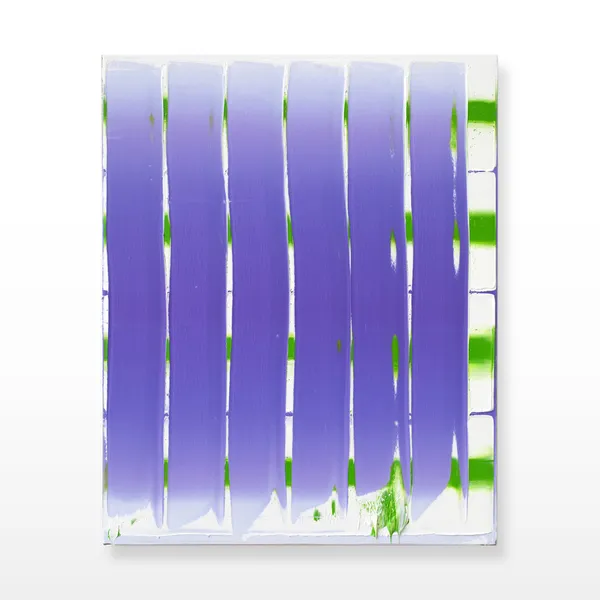
Krauskopf’s practice is defined by a rigorous engagement with process. His paintings typically begin on pre-worked or monochrome grounds that are subsequently reactivated through decisive painterly operations. Using plexiglass squeegees of varying widths, he drags, compresses, scrapes, and overlays layers of oil paint. These interventions are not expressive gestures in a traditional sense; rather, they function as calibrated material acts. Overpainting, abrasion, and reduction are central to his method, positioning each painting as a record of accumulation and erasure, presence and withdrawal.
Colour in Krauskopf’s work operates as a material condition rather than a symbolic language. Intensely saturated hues coexist with restrained grey or near-monochrome passages, generating tensions between opacity and translucency, depth and flatness. Earlier layers frequently remain visible as latent traces, allowing the surface to function as a stratified field in which time and material resistance are embedded. The painting does not resolve into an image; it remains a site of negotiation.
Art historian Jörg Heiser, in his essay The Dark Side of Power and the Light Parts of the Night (2017), situates Krauskopf’s work within a broader cultural and perceptual framework. Writing from a studio visit, Heiser describes the large-format works of the “Grünstein” and “Struktur” series as fields of horizontal squeegee strokes producing “a regular, irregular sequence of soft transitions and harsh contrasts” (Heiser, 2017). These paintings, often dominated by blue-black and grey tonalities, evoke liminal conditions between night and dawn without collapsing into representation. Heiser emphasizes that their experiential origins—an early-morning view over the Königssee—are filtered through contemporary anxieties rather than romantic nostalgia. The paintings operate, in his words, as an “aesthetic sublimation” of complex emotional states rather than as political instruments.
Relationality between works is central to Krauskopf’s thinking. Paintings gain resonance through variation and contrast within exhibition space. Large, dark canvases are often countered by smaller works introducing chromatic intensity or structural disruption. Certain reduced grey or black paintings—referred to by the artist as “Bad Boys”—function as catalysts within this choreography, sharpening perception and marking sites of ongoing development.
Krauskopf’s work has been exhibited widely in institutional contexts, including the Albertinum Dresden, Mies van der Rohe Haus Berlin, Kunsthalle Lingen, and Kunsthaus Kaufbeuren. His paintings are held in major public collections such as the Albertinum / Galerie Neue Meister Dresden, Museum der Bildenden Künste Leipzig, and the Sammlung des Deutschen Bundestages. In 2015, he received the Falkenrot Prize in Berlin.
Today, Krauskopf lives and works in Berlin. His practice continues to refine a painterly language grounded in reduction, material precision, and temporal awareness—one that unfolds through sustained attention rather than immediacy.
Jörg Heiser (2017), “Die dunkle Seite der Macht und die hellen Teile der Nacht. Zu neuen Bildern von Peter Krauskopf“, in STRUKTUR. Leipzig: MMKoehn Verlag & G2 Kunsthalle
References
-
Heiser, J. (2017) The Dark Side of Power and the Light Parts of the Night. On Peter Krauskopf's new paintings. Exhibition text.
-
Bernhard, T. (1963) Frost. Frankfurt am Main: Insel.
-
Heine, H. (1844) 'Nachtgedanken', in Zeitgedichte.
-
Ruppert, W. (1998) Der moderne Künstler. Frankfurt am Main: Suhrkamp. Heusler, A. (2008) Das Braune Haus. Munich: DVA.


Education
-
Hochschule für Grafik und Buchkunst Leipzig
-
Meisterschüler under Prof. Arno Rink, Leipzig
Awards
-
2015 – Falkenrot Prize, Berlin
Selected Solo Exhibitions
-
2007 – Peter Krauskopf, Mies van der Rohe Haus, Berlin
-
2008 – Peter Krauskopf, Forum Kunst Rottweil, Rottweil
-
2012 – Landschaft mit abstraktem Gemälde, Galerie Neue Meister / Albertinum, Dresden
-
2017 – Struktur, G2 Kunsthalle Leipzig, Leipzig
-
2018 – Drift, Kunsthaus Kaufbeuren, Kaufbeuren
-
2023 – studien/ALTESBILD, Caspar-David-Friedrich-Zentrum, Greifswald
-
2024 – Initialen, Walter Storms Galerie, Munich
Selected Group Exhibitions
-
Museum der bildenden Künste Leipzig, Leipzig
-
Museum Pfalzgalerie Kaiserslautern, Kaiserslautern
-
Kunsthalle im Lipsiusbau, Dresden
-
Bluerider ART, Taipei / Shanghai / London
Public Collections
-
Albertinum / Galerie Neue Meister, Dresden
-
Kupferstich-Kabinett, Dresden
-
Germanisches Nationalmuseum, Nuremberg
-
Sammlung des Deutschen Bundestages, Berlin
-
Museum Schloss Morsbroich, Leverkusen
-
Stiftung Moritzburg – Kunstmuseum des Landes Sachsen-Anhalt, Halle (Saale)