


A Conversation with Emanuel Seitz
Interviewer: Louis Buysse
Occasion: On the artist's evolving body of work, his relationship with abstraction, and the persistent return of the stripe
Context: The following conversation traces the artist's personal and conceptual development across decades of painting.
On Beginnings and Artistic Foundations
Louis Buysse: Emanuel, could you briefly introduce your artistic trajectory?
"I studied at the Academy of Fine Arts in Munich, where I was taught by Günther Förg, and I've been working full-time as an artist since 2003. Over the years, I've developed a body of work that revolves around abstraction - broadly split into two directions: the stripe paintings, and another strand of more freely abstract compositions. Both lines coexist in my practice."
Seitz's practice emerged from early experiments with landscape and figuration, which he gradually reduced until they collapsed into abstraction.
"I began with landscape painting, but over time, I reduced the image more and more. Eventually, I felt the need to let go of figuration altogether. That's when the stripe paintings started - as a kind of conceptual investigation. For five or six years, I focused almost entirely on those. Later, I began exhibiting non-stripe works again - abstract compositions that evolve differently. Now, I move between the two."
This duality - between the structural rigor of the stripe and a looser, more intuitive abstraction - remains a central tension in his work. The trajectory recalls the reductive path of artists like Nicolas de Staël, whose landscape-based abstractions similarly disassemble pictorial reference.
On Process, Color, and Time
LB: In your practice, what comes first - the choice of color, or the structural idea?
"I usually begin with a small selection of colors - a kind of setup. Then I start directly on the canvas. The work develops from there. Each stripe is a decision made in the moment. I don't know what the next one will be until I get there."
There is no predetermined blueprint - no system, only response. The process becomes a lived experience in front of the canvas.
"It's a journey. I never know the result in advance. That's what makes painting so compelling for me - the openness, the fact that it's never fixed."
LB: When I visited your studio, I noticed you work with raw pigment. Could you speak to that?
"Yes, I work with pure pigments and binders. That's how I get such direct, vibrant color. It's not just a material thing - it's a dialogue. I put a color on the canvas, then ask: what comes next? Each choice leads to the next. It's a collaboration with the palette, in a way."
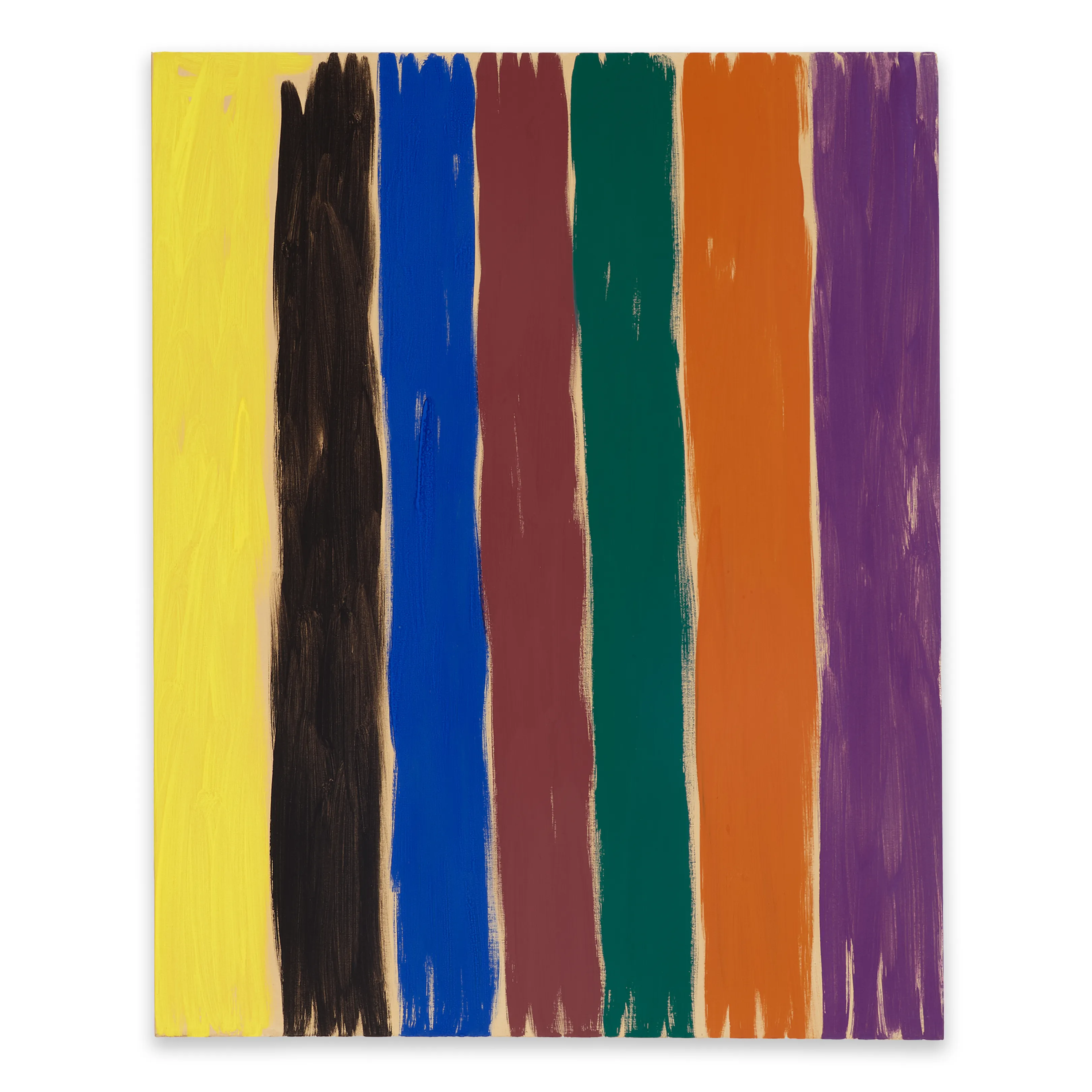
Emanuel Seitz, Untitled, 2024
On Silence, Rhythm, and Disruption
LB: Viewers often describe your work as silent or meditative. Do you see it that way?
"I try to keep things simple. I know people don't always understand why I choose certain colors - sometimes the combinations feel disturbing or 'wrong.' But that's intentional. I'm not interested in harmony for its own sake. Sometimes I want a painting to contain a moment of friction - something unresolved. That's where the tension lies."
The work resists resolution. It oscillates between calm and disruption, between visual stillness and chromatic instability.
LB: Do you see your use of horizontal and vertical structures as referring to landscape, architecture, or musical rhythm?
"Yes, you could say that. They can be read like a walk, or like a kind of horizontal landscape. There's a rhythm - a sequence - that structures the composition. It's intuitive, but it does relate to space."
On Digital Media and Contemporary References
LB: Have you ever considered exploring digital media - for instance, like David Hockney's iPad paintings?
"I really like Hockney's digital works - especially the Grand Canyon paintings, the still lifes, the interiors. His use of color is fascinating. I think there are parallels with my own horizontal canvases, though I'm not working with figuration or narrative. Still, I want to keep my work physical. I'm not interested in translating it into digital formats. It's about surface, material, pigment."
Seitz's admiration for artists like Hockney and de Kooning is rooted in their chromatic intelligence and spatial energy, not in their subject matter or mediums.
"Sometimes I collect images or palettes - a kind of moodbook - from painters I admire. I try to understand what kind of mood is in their color systems. Then I translate that feeling into my own work."
On Failure, Repetition, and the Stripe
LB: Do you archive unfinished or unrealized works? What happens when a painting fails?
"I don't work in layers, so if a painting fails, I can't fix it. I can't paint over it. I throw it away and start again. There's no editing - just new beginnings."
This clarity, this refusal of revision, speaks to a commitment to presence and process.
LB: Do you think the stripe will always be part of your work - or will it eventually disappear?
"That's the big question. I don't know where it will end - or if it will. The stripes disappear sometimes, then return again. I haven't found a conclusion. I haven't fully understood them. And I don't want to repeat myself. But they keep coming back."
The stripe, in Seitz's work, is less a motif than a recurring question - an unresolved form that insists on being restated.
"Maybe it's an obsession. I've made so many stripe paintings, but never the perfect one. I could make ten in a month and still feel the same. That's also a kind of relief - knowing I'll never arrive. Each painting is just part of a longer game."
LB: It's like playing Tetris - there's always another move to make.
"Exactly. And that's why I relate to the U2 song 'I Still Haven't Found What I'm Looking For'. That's how it is with the stripes. They keep challenging me. The search never ends."`
Closing Note
This open-endedness - this refusal of resolution - is perhaps the most essential element in Emanuel Seitz's work. His paintings, whether striped or not, are not about finding an answer, but about continuing to ask. They are sites of attention, gesture, and hesitation. Each one is a proposition, a search, a moment in an unfinished conversation.
"I still haven't found what I'm looking for."
- Emanuel Seitz, quoting U2 (1987)

