


Tycjan Knut, 2026
Photo © Buysse Gallery / Tycjan Knut. All rights reserved.
Tycjan Knut's (b. 1985, Warsaw) practice cannot be understood without situating it within the longer trajectory of Central and Eastern European abstraction. Constructivism, emerging in the early twentieth century through figures such as Kazimir Malevich and later developed spatially by artists like Naum Gabo, was never merely formal. It was structural, ideological, and bound to questions of order and reconstruction in the aftermath of social rupture. Geometry functioned as a proposition - clarity as a political and philosophical stance.
Knut's work operates in the shadow of that legacy, yet it refuses its dogma. Where early Constructivism proposed certainty, Knut introduces calibrated instability. His surfaces bend. They hesitate. They fold. Geometry remains present, but it is no longer authoritarian. It becomes perceptual rather than declarative.
If Malevich's Black Square of 1915 marked a metaphysical zero, Knut's reductions resist such absolutism. His canvases are not symbols of transcendence; they remain resolutely material. The linen, the pigment, the modulation of surface all insist on physical presence. This is not Suprematist transcendence - it is grounded structural awareness.
At the same time, Knut's work cannot be framed solely through Polish abstraction of the 1950s and 1960s, even though that lineage is relevant. In that period, abstraction in Eastern Europe functioned as an indirect language of autonomy under political constraint. It carried warmth, atmosphere, and interiority distinct from the industrial hardness of Western geometric abstraction. Knut inherits this tonal sensibility, yet he articulates it in a contemporary vocabulary.
One of the recurring misreadings of his work concerns color. Beige, earth tones, muted gradients - these are often interpreted as safe, harmonious, or interior-friendly. Yet this reading is reductive. Neutrality in his work functions structurally, not decoratively. In an era defined by visual saturation, chromatic restraint becomes a radical strategy of resistance. Warmth does not equal compliance. Accessibility does not negate complexity.
The assumption that serious art must be visually difficult is equally flawed. The history of twentieth-century art already dismantled that hierarchy. When Joseph Beuys placed felt and fat within gallery contexts, or when Minimalist artists reduced form to industrial repetition, the question was never difficulty but context and conceptual framing. Knut's paintings are not obscure objects requiring hermetic decoding. Their rigor lies in proportion, tension, and spatial calibration. Complexity here is optical and structural, not theatrical.
Moreover, his work negotiates architecture with unusual precision. The paintings do not merely hang within space; they modulate it. This spatial sensitivity inevitably recalls artists such as Lucio Fontana, whose cuts activated depth, or even Naum Gabo's constructive interventions into space. Yet Knut's gestures are quieter. The fold is not rupture. It is pressure. It suggests volume without abandoning painting's surface.
What ultimately distinguishes Knut's position is recognizability. His visual language is increasingly iconic - not in a commercial sense, but in its consistency of structural logic. The recurring bend, the subtle displacement, the calibrated chromatic gradient: these elements form a vocabulary that is both historically aware and unmistakably contemporary.
The challenge, therefore, is not to defend his work from accusations of accessibility, but to articulate accessibility as a deliberate and intellectually grounded choice within a broader European history of abstraction.
Raised within a studio shaped by geometric discipline, Knut internalized structure before questioning it. His abstraction emerges from that inherited order yet deliberately unsettles it. Geometry, in his work, is not purity but tension under pressure. What appears stable remains slightly displaced, extending a Constructivist vocabulary into a contemporary condition of perceptual doubt.
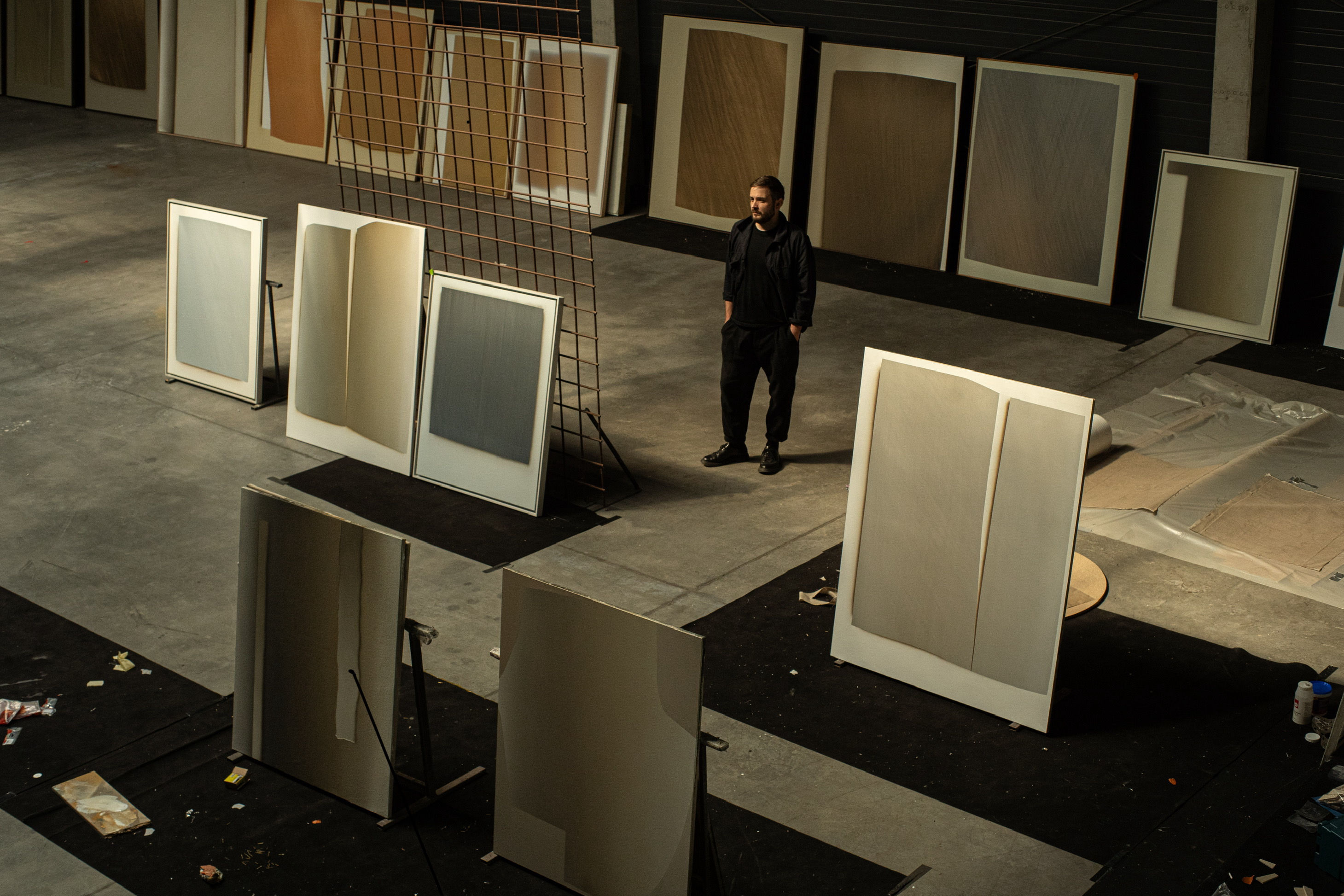 Tycjan Knut, 2026
Photo © Buysse Gallery / Tycjan Knut. All rights reserved.
Interview conducted by Louis Buysse
Q: How do you consciously position your work in relation to early Constructivism, particularly the work of Kazimir Malevich and the structural clarity of Suprematism? Do you see your practice as extending or softening the ideological rigidity associated with early twentieth-century geometric abstraction?
A: "was raised in Poland at a time when the legacy of Constructivism was still very present and influential. Polish modernism carried a strong respect for geometry, structure, and disciplined abstraction, and that atmosphere shaped my early visual education.
My father is a geometric abstract painter, so I grew up in a studio environment surrounded by planers, measured compositions, and a very conscious approach to structure and balance. Geometry wasn't something theoretical to me - it was part of everyday life. I absorbed the language of abstraction almost intuitively.
I think the Constructivist legacy in my work is less about direct quotation and more about an internalized sense of order, restraint, and clarity. Even when I work with gradients, shadow illusions, or dripping paint, there is always an underlying structural thinking - a tension between control and freedom. That dialogue between discipline and sensitivity is probably where the legacy continues to live in my practice."
Tycjan Knut, 2026
Photo © Buysse Gallery / Tycjan Knut. All rights reserved.
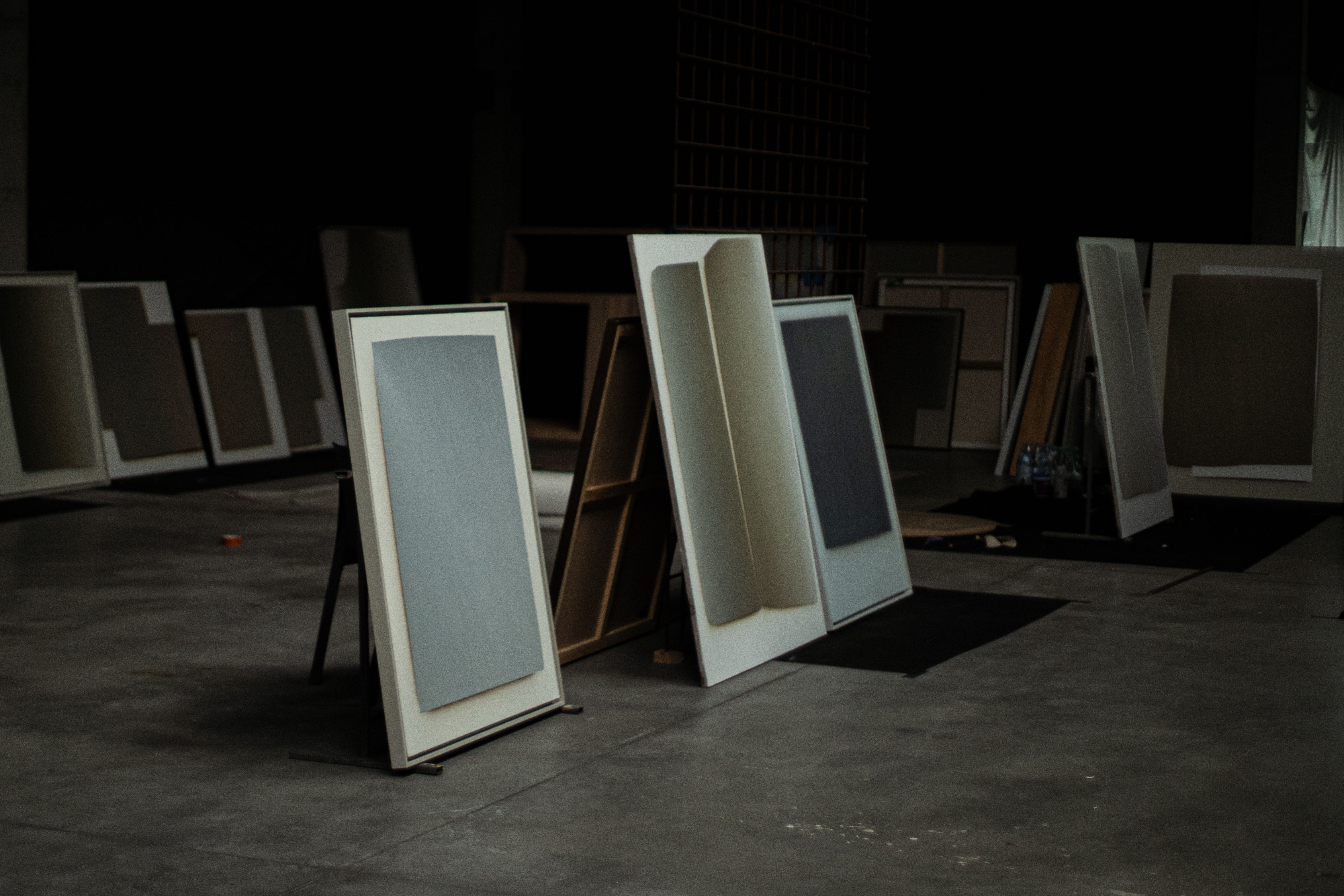
Q: Your compositions appear stable at first glance, yet they introduce subtle deviations and folds. Is this a deliberate destabilization of Constructivist order? How important is hesitation within structure for you?
A: "wouldn't describe myself as a geometric painter in a strict sense. I don't use perfect, stable geometric figures. Even when a shape appears square or rectangular, it's usually slightly tilted, disturbed, or destabilized. There is always a subtle shift.
I'm quite far from the legacy of Concrete Art - that belief in pure, rational, self-contained form. My relationship to geometry is much more emotional. I use sharp lines and clear compositions, but they're not about mathematical purity. They're about tension.
So if someone experiences instability in my geometry, I think that's accurate - but it's intentional. The forms are never fully grounded. They lean, they hover, they feel slightly unsettled. That instability reflects a psychological or perceptual condition rather than a formal problem. It's geometry under pressure."
Q: In a visually saturated contemporary culture, do you consider chromatic restraint a political gesture? Can neutrality function as resistance?
A: "I don't engage directly with political themes. My work operates in a different register - it's more concerned with perception, tension, and internal states than with commentary on current events."
Q: There remains a belief that serious art must be visually challenging. How do you respond to the idea that accessibility undermines conceptual depth? Is complexity in your work primarily perceptual rather than symbolic?
A: "would say the complexity in my work is primarily perceptual rather than symbolic. I'm not interested in encoding meanings or constructing narratives. My approach is fundamentally formal.
The tension, instability, balance - all of that operates on the level of perception. It's about how the eye moves, how space shifts, how the body responds. I'm much more concerned with those physical and optical experiences than with symbolism."
Tycjan Knut, 2026
Photo © Buysse Gallery / Tycjan Knut. All rights reserved.
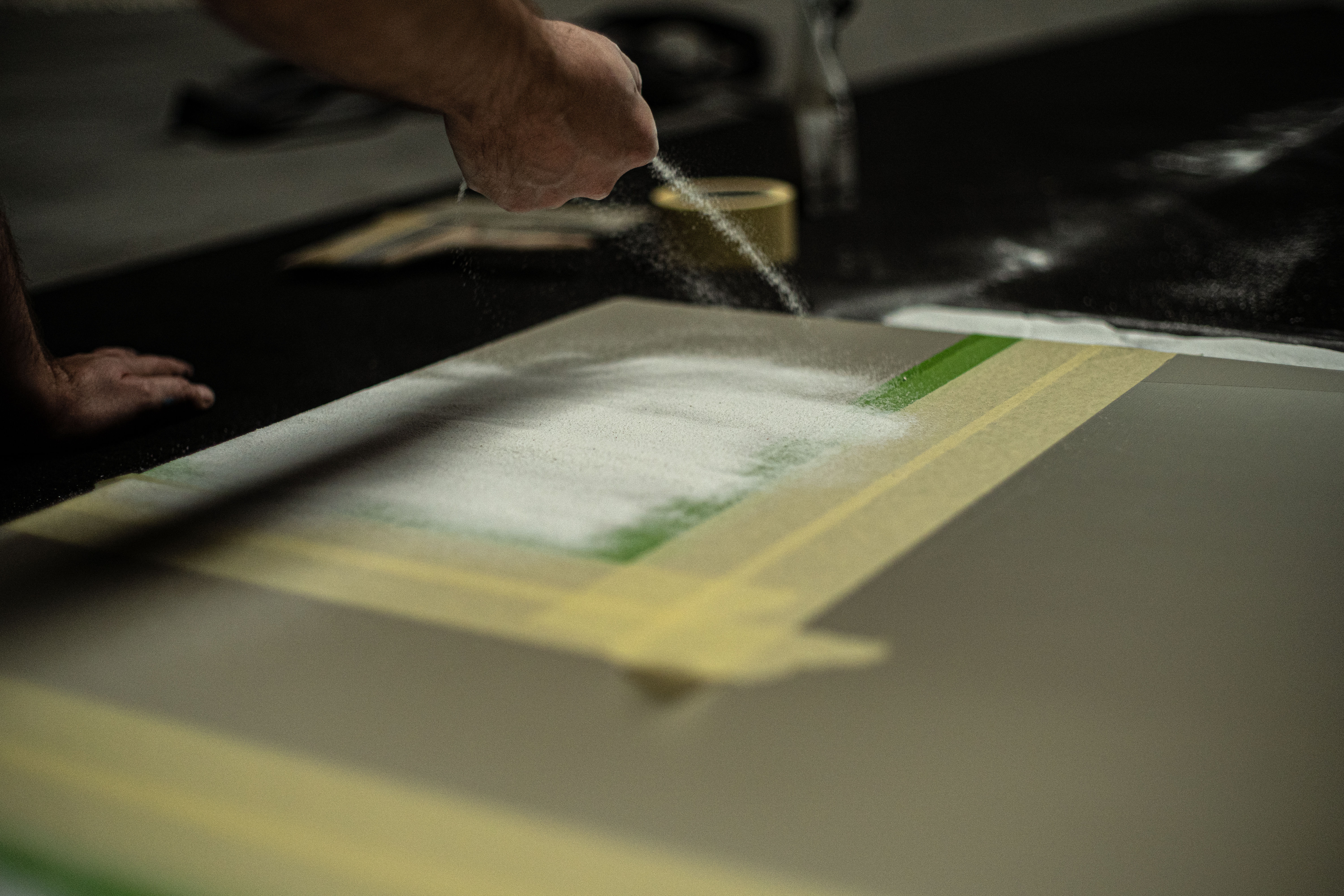
Q: Your paintings often seem to adjust or recalibrate architectural space. How do you think about the relationship between painting and architecture? Is the fold a sculptural gesture, or does it remain fundamentally painterly?
A: "I wouldn't describe the fold as a sculptural gesture. It remains fundamentally painterly.
What I'm doing is using illusion - particularly the illusion of shadow - to create a separation between figure and background. That separation has always been central in my work. The fold is simply another way of articulating that boundary.
It's not derived from architecture or sculpture. The principles guiding it are the same ones that structure my paintings more generally: composition, tension, proportion, direction. The fold might appear spatial, but it's really a compositional device - a way to intensify the dialogue between surface and depth.
For me, it's about adding another vocabulary within painting itself. Another tool to trace and follow the line that divides figure and ground. It extends the internal logic of the painting rather than moving into another discipline."
Q: Your visual language has become increasingly recognizable. How do you maintain consistency without repetition? At what point does a formal vocabulary become a signature?
A: "I think a formal vocabulary becomes a signature when it reaches a certain inevitability - when the decisions no longer feel decorative or experimental, but necessary.
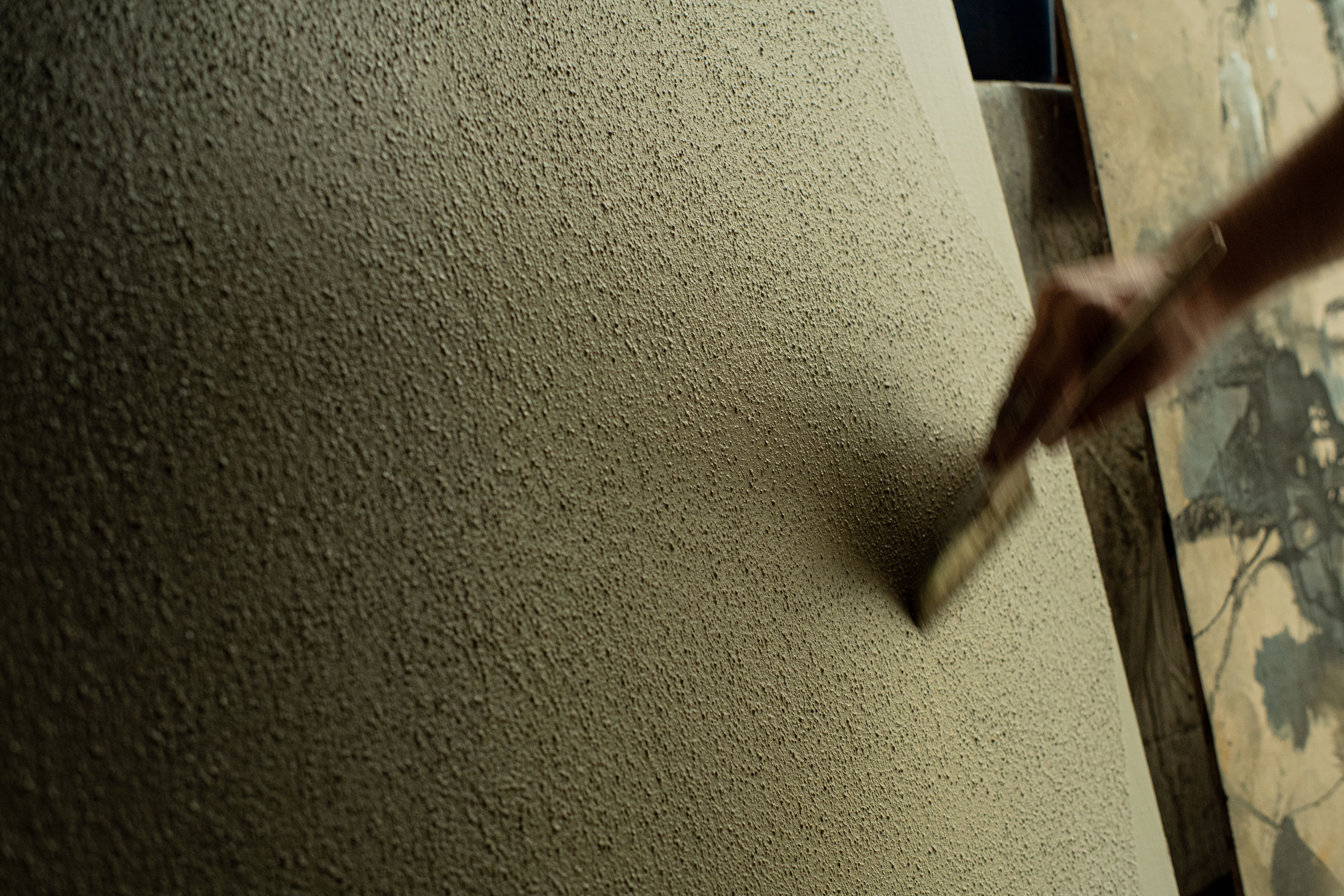
I've been developing this language for over twenty years. Each year I've added something - a new tension, a new spatial strategy, a new technical solution. It's been a slow accumulation rather than a fixed formula.
In the past few years, with exhibitions in China, the U.S., and across Europe, I feel that this long process is becoming more visible. People are starting to recognize the continuity behind the work - not just individual paintings, but the system evolving over time.
At the moment, I'm still expanding the vocabulary. I'm adding rather than reducing. But I believe that eventually the language will condense. It will become more precise, more distilled. And perhaps that's when it fully becomes a signature - when complexity is reduced to its most essential gestures."

